
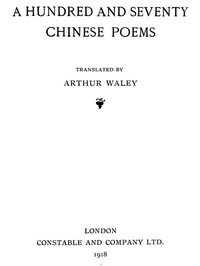
A Hundred and Seventy Chinese Poems by Arthur Waley
Let's be clear from the start: this isn't a book you read for a twisty plot. 'A Hundred and Seventy Chinese Poems' is a journey, not a destination. Assembled and translated by the legendary scholar Arthur Waley, it’s a gathering of voices spanning from 1100 BC to around 1400 AD. You’ll meet all sorts of people through their words: a weary conscript missing his family, a tipsy poet celebrating with friends, a recluse finding peace in the mountains, and even a wife gently scolding her traveling husband. There’s no single story, but a beautiful, meandering path through the everyday joys, sorrows, and observations of lives lived long ago.
Why You Should Read It
I keep this book on my nightstand. Why? Because its magic is in its startling simplicity and timelessness. Waley’s translations are clean and direct—they don’t feel dusty or academic. The themes are universal: love, loss, the beauty of nature, the passage of time, the desire for a simpler life. You don’t need any background in Chinese history to feel the ache in a poem about war or the quiet joy in one about drinking wine under a plum tree. It cuts right through the centuries. Reading it feels like quieting your own mind. In a world of constant stimulation, these poems offer a deep, refreshing breath of clarity and calm.
Final Verdict
This book is a perfect companion for anyone who feels overconnected yet lonely, or who just loves beautiful, concise writing. It’s for the reader who wants to dip in and out of something meaningful, reading a poem or two at a time. It’s for fans of writers like Mary Oliver or Billy Collins who appreciate sharp observations about being human. If you’re looking for a fast-paced thriller, look elsewhere. But if you want a book that feels like a wise, quiet friend—one that reminds you of the shared threads in all human experience—then this collection is a gift. It’s less of a book to finish and more of a place to return to, again and again.
This text is dedicated to the public domain. Knowledge should be free and accessible.
Jennifer Lee
11 months agoFinally found a version that is easy on the eyes.
Karen White
3 months agoAfter a thorough walkthrough of the table of contents, the visual layout and supporting data make the reading experience very smooth. It’s hard to find this much value in a single source these days.
Paul Miller
11 months agoComparing this to other titles in the same genre, the author manages to bridge the gap between theory and practice effectively. I am looking forward to the author's next publication.
Karen Thomas
4 months agoThe author provides a very nuanced critique of current methodologies.




William Perez
7 months agoComparing this to other titles in the same genre, the structural organization allows for quick referencing of key points. The insights gained here are worth every minute of reading.