
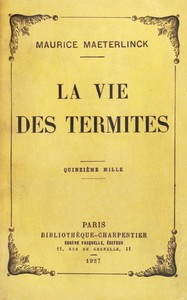
La vie des termites by Maurice Maeterlinck
So, what's this book actually about? 'La vie des termites' isn't a novel with a plot. Instead, Maeterlinck acts as our guide on a tour of a termite colony. He describes their world in stunning detail. We learn how they build towering, ventilated cities from their own saliva and dirt. We see the strict castes: the blind workers, the giant-headed soldiers, and the royal couple who are the colony's sole parents. The 'story' is the daily life and death struggle of this society—how they farm fungus for food, defend against invaders, and maintain their complex home without ever seeing the sun.
Why You Should Read It
Here's the thing: Maeterlinck doesn't just give us facts. He writes with wonder and a touch of poetry. He's amazed by these creatures, and it's contagious. The book makes you ask big questions. When you see worker termites tirelessly repair a breach, knowing they'll be killed in the process, is that bravery or just programming? Their society has no crime, no rebellion, and perfect efficiency. It's a utopia, but also a bit of a nightmare with no individual freedom. Reading this, you can't help but draw parallels to human cities, armies, and even our own social instincts. It's a mirror held up to the natural world that reflects back surprising truths about ourselves.
Final Verdict
This book is perfect for curious minds who love natural history, but want something with more soul than a dry textbook. If you enjoyed shows like David Attenborough's 'Life' or books like 'The Hidden Life of Trees,' you'll find a kindred spirit in Maeterlinck. It's also a great pick for anyone interested in philosophy or sociology, as it quietly challenges our ideas about intelligence, society, and purpose. Fair warning: it was written in the 1920s, so some of the science is dated, but the sense of awe and the big questions are timeless. Grab it for a truly mind-expanding read that turns a humble insect into a profound mystery.
This book is widely considered to be in the public domain. Preserving history for future generations.
Anthony Williams
1 year agoBeautifully written.
Robert Miller
2 years agoText is crisp, making it easy to focus.
Emily Thomas
2 years agoA must-have for anyone studying this subject.
Richard Thompson
1 year agoThis book was worth my time since the narrative structure is incredibly compelling. Thanks for sharing this review.
Kenneth Torres
1 year agoEnjoyed every page.