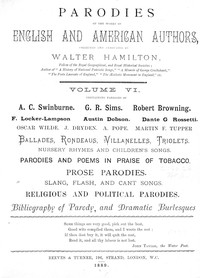
Parodies of the works of English & American authors, vol. VI by Walter Hamilton
Let's be clear from the start: this isn't a novel. You won't find a sweeping plot or a cast of characters here. Think of it more like a curated party trick from the Victorian era. Editor Walter Hamilton pulled together a collection of the best, funniest, and most biting parodies written by anonymous wits, all targeting the heavyweights of 19th-century English and American poetry and prose. The 'story' is the slow reveal of each target. One page you're reading a perfectly serious-sounding ode, and the next you realize it's a brilliant, exaggerated send-up of Alfred Lord Tennyson's flowery style. Another piece might twist the moralizing tone of a popular novelist into something absurd. The joy is in the 'aha!' moment when you recognize the original voice being mimicked and mocked.
Why You Should Read It
First, it's just plain fun. There's a childlike glee in seeing authority figures—even literary ones—get a pie in the face. But beyond the laughs, this book is a fascinating social document. Parody is a form of criticism and conversation. These unknown writers are telling us what was considered overwrought, pretentious, or clichéd in their time. It makes the literary giants feel human and their work feel like part of a living, breathing discussion, not just untouchable classics on a pedestal. Reading it today, you get a double layer: you're in on the original 1880s joke, and you're also seeing how humor and style have (or haven't) changed.
Final Verdict
This is a niche read, but a wonderfully rewarding one. It's perfect for literature lovers, history nerds, and anyone who enjoys a clever inside joke. If you've ever read a famous poem and thought, 'Okay, but what if it was sillier?' this is your book. It helps to have a passing familiarity with Victorian poets, but half the fun is looking up the originals as you go. It's not a page-turner in the traditional sense, but it's a delightful bedside or coffee table book to dip into. Just be warned: after reading it, you might never look at a solemn epic poem the same way again.
This work has been identified as being free of known copyright restrictions. Knowledge should be free and accessible.
Sarah Wilson
2 months agoThe clarity of the introduction set high expectations, and the emphasis on ethics and sustainability within the topic is commendable. Well worth the time invested in reading it.
Joseph Scott
1 year agoAfter hearing about this author multiple times, the flow of the text seems very fluid. Exceeded all my expectations.
Brian Lopez
2 years agoPerfect.
Joshua Walker
1 year agoNot bad at all.
Christopher Martin
2 years agoThis digital copy caught my eye due to its reputation, the language used is precise without being overly academic or confusing. This has become my go-to guide for this specific topic.