
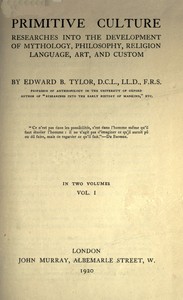
Primitive culture, vol. 1 (of 2) : Researches into the development of…
Let's be clear: Primitive Culture is not a novel. There's no plot in the traditional sense. Instead, think of it as an intellectual adventure. Tylor sets out on a mission to prove that human culture evolves in a pattern, much like species do. He gathers evidence from all over the globe—stories from missionaries, reports from travelers, studies of ancient texts—to show that similar ideas about souls, gods, and magic pop up everywhere.
The Story
The 'story' is Tylor building his case, chapter by chapter. He starts with his big idea: the study of 'primitive' cultures (a term we'd handle very differently today) is the key to understanding our own. He then dives into what he considers the foundation of all religion—the belief in spiritual beings, or 'animism.' From there, he tracks how these beliefs might have grown into the complex religions and philosophies of the 'civilized' world. The narrative is the journey of his argument, as he tries to fit thousands of years of human belief into a single, understandable framework.
Why You Should Read It
You should read it because it will change how you see the world in your own home. Tylor's concept of 'survivals' is genius. When he points out that saying 'bless you' after a sneeze is a leftover from the belief that your soul could escape your body, it clicks. Suddenly, folklore isn't just old stories; it's a living record. While his Victorian confidence and some of his conclusions feel dated now, the core thrill is watching a foundational mind at work. He was trying to make sense of humanity with the tools he had, and that ambition is still gripping.
Final Verdict
This is a book for the curious non-expert who loves ideas. It's perfect for anyone interested in the history of religion, folklore, or just why we humans do the weird things we do. It's not a light read—you have to be okay with 19th-century prose and some outdated perspectives—but if you approach it as a historical document, a snapshot of a brilliant mind trying to crack a universal code, it's incredibly rewarding. Think of it less as a textbook of absolute truth, and more as the fascinating, flawed origin story of how we started to study ourselves.
This publication is available for unrestricted use. You are welcome to share this with anyone.
Jessica White
1 month agoIt’s refreshing to see such a high standard of digital publishing.
Patricia Thompson
1 year agoI started reading this with a critical mind, the clarity of the writing makes even the most dense sections readable. I feel much more confident in my knowledge after finishing this.
Matthew Harris
1 year agoAfter a thorough walkthrough of the table of contents, the visual layout and supporting data make the reading experience very smooth. This has become my go-to guide for this specific topic.
Charles Nguyen
4 months agoFast paced, good book.

Charles Harris
8 months agoUnlike many other resources I've purchased before, the insights into future trends are particularly thought-provoking. Truly a masterpiece of digital educational material.