
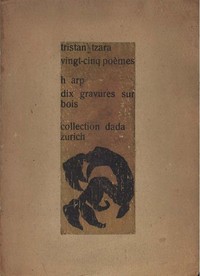
Vingt-cinq poèmes by Tristan Tzara
Let's be clear from the start: Vingt-cinq poèmes (Twenty-Five Poems) isn't a story in any traditional sense. Published in 1918, it's a manifesto in poetic form from the heart of the Dada movement. There's no plot, no characters. Instead, Tristan Tzara presents a series of explosive, rule-breaking texts that actively fight against logic and elegant craftsmanship.
The Story
There isn't one, and that's the point. The 'story' is the performance. You open the book and immediately get hit with poems that look like random lists of objects ('dragonfly train cigar'), playful nonsense sounds, and typographical experiments. One famous piece, "Pour faire un poème dadaïste" (To Make a Dadaist Poem), is just a recipe: cut words from a newspaper, shake them in a bag, and tape them down in the order they fall out. The 'story' is the act of creation itself, handed over to chance and the reader. It’s the sound of a whole generation, shell-shocked by World War I, screaming that the old ways of making sense had failed them utterly.
Why You Should Read It
I loved it because it’s so refreshingly impatient. This isn't poetry to be analyzed quietly in a library; it's meant to be experienced, maybe even yelled. Tzara isn't trying to make you feel something specific—he's trying to make you do something, to engage. Reading it feels collaborative. You puzzle over the word combinations, you laugh at the sheer audacity, and you might even try his cut-up method yourself. It strips away all pretense and asks the most basic question: why do we insist that art must mean something? Sometimes, it can just be—loud, strange, and alive.
Final Verdict
This book is absolutely not for everyone. If you want beautiful, rhyming verses about nature, run the other way. But if you're curious about where modern art and poetry got their rebellious streak, this is essential reading. It’s perfect for anyone interested in the roots of surrealism, punk aesthetics, or experimental writing. It’s also great for creative people feeling stuck; a few pages of this chaos is better than any creativity workshop. Think of it less as a book and more as a historical artifact of pure, unadulterated artistic rebellion. Keep an open mind, embrace the nonsense, and enjoy the ride.
This book is widely considered to be in the public domain. Distribute this work to help spread literacy.
Emma Allen
8 months agoI stumbled upon this title and the arguments are well-supported by credible references. Exactly what I needed.
Amanda Walker
1 year agoI came across this while browsing and it provides a comprehensive overview perfect for everyone. A true masterpiece.
Deborah Wright
9 months agoAs someone who reads a lot, the emotional weight of the story is balanced perfectly. Highly recommended.
Margaret Rodriguez
2 years agoNot bad at all.
Joshua Lee
1 year agoThanks for the recommendation.